
Category: Uncategorised
more frost
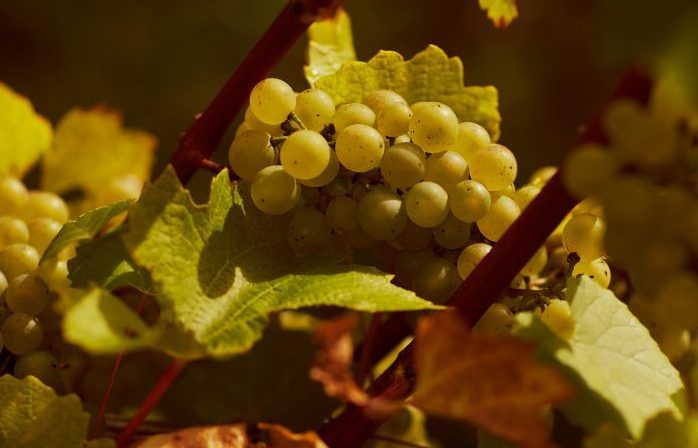
The vines are fat with grapes, full and sweet and juicy and just ten days from pickable perfection. But, just as the finishing post is almost touchable, the spectre of early Autumn frosts has appeared.
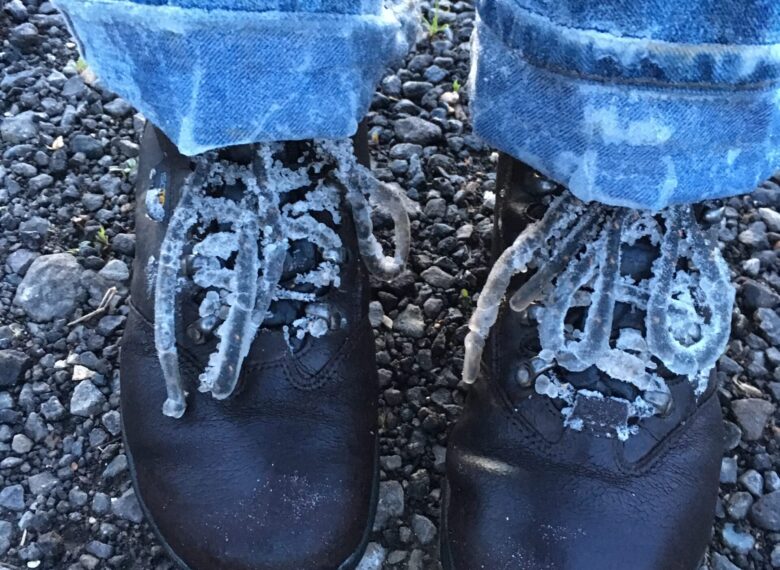
Our plucky Frost Warriors were out in the vineyard at 5.30 on Monday morning and again until 2 on Tuesday morning lighting candles. It seems to have done the trick because the thermometer in row 135 dropped to 0.2C and no lower, yet on my way back to bed the roadside verges were rimed with frost and parts of rural Hampshire got down to -2C…
-2C doesn't sound too cold, but even an hour of it in the vineyard and the glorious 2018 growing season would have come to nothing - frozen grapes need picking within hours and we would barely have been able to harvest 10% of what is out there.
You'd spend all night watching the flames if you weren't so cold!
frost
If ever you meet an English grape grower in late April or early May, chances are they will be a little distracted. This is the time of the year when a late frost can decimate the vineyard.
Grape vines are very tough indeed during the winter – they can deal with -40C for long periods – but when the buds start to swell and burst in the spring they get a lot less tough. Once the fourth leaf has separated from the stem any temperatures below -2.8C will kill 90% of the primary shoots on the vine and anything below -1C will do some damage. Sometimes secondary and tertiary buds will come through, but they produce a lot less fruit than the primaries and, while they ensure the vine’s survival, they do nothing for the vineyard’s finances.
Over the decades, and around the world, people have been coming up with different ways to limit the damage the frost wreaks. In Burgundy they traditionally set light to large bales of straw to create a layer of smoke over the vineyards that reduces the impact of a sudden thawing of the buds. Where there is plenty of stored water, sprinkler systems can be used to encase the buds in ice which, counterintuitively, insulates them from getting any colder than about -1C. There are even huge fans that blow the cold, still air at ground level some 300 feet in to the air creating a sort of convection current, drawing warmer air in from elsewhere.
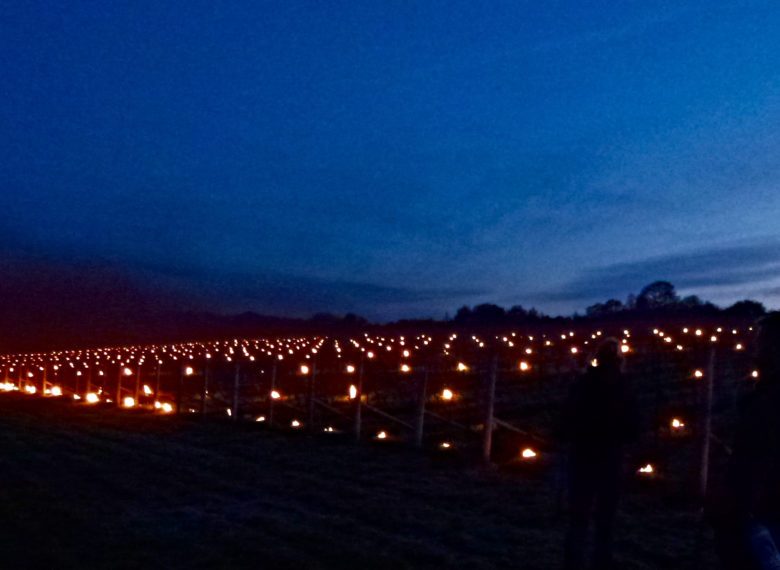
At Burge’s Field we use candles – very big candles, each about the size of a bucket. Every year we set them out in the vineyard at about 400 to the acre. Then we wait. An alarm on the weather station sends out a text when the temperature gets to 0.5C. If it keeps falling then the calls go out and a dedicated band of frost warriors leaps out of bed and converges on the vineyard. Armed with flaming weed wands we speed up and down the alleys lighting the candles – and, thankfully, they really work. In 2017, for example, the frosts were the worst for many years and on the 28thApril the temperatures outside the vineyard got down to -5.8C. We were hit hard, losing some 50% of the buds in the lowest lying and furthest advanced areas but, if we hadn’t had the candles keeping temperatures above -3C we would have lost probably 75% of the whole vineyard.
Despite the unavoidable dread at the potential damage, there is an upside to frost duty – the moon sailing above a vineyard filled with flickering candles and then the gradual lightening of the sky in the east as the moon is extinguished by the arrival of the sun.
sheep made fertiliser
In the 17th and 18th centuries, the upper Itchen was at the forefront of the development of water-meadows, an agricultural innovation that made use of the fact that, year-round, the water that emerges from chalk springs is an almost constant 10° Centigrade. Using a carefully constructed series of channels, water from the main river was allowed to trickle out across the fields on either side which, like central heating, in the early spring and late autumn kept the frost off the grass, allowing it to start or continue to grow several weeks earlier or later than on land not flooded.
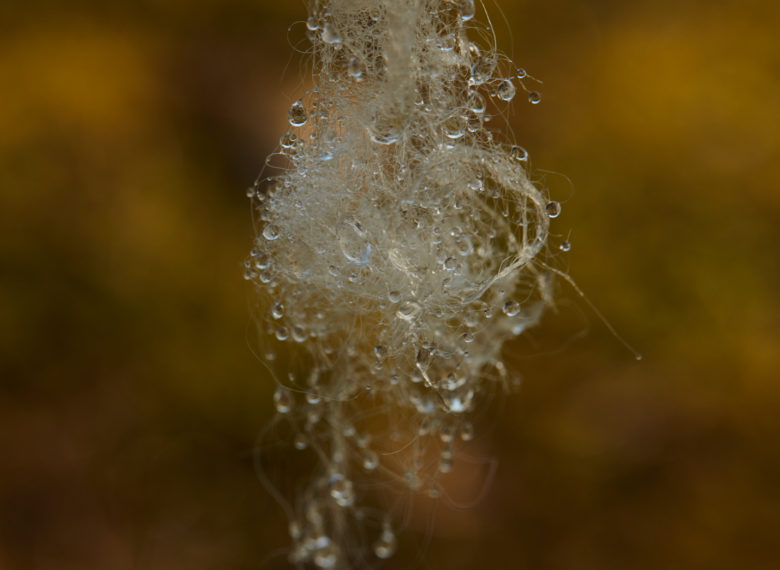
The reason why the farmers in these parts went to all this bother was to graze sheep, not so much for their wool and meat, as their dung. Each night the sheep would be ‘folded’ on to the arable fields on the bottom slopes of the downs adjacent to the meadows and the dung from a day spent devouring rich meadow grasses would fertilise these fields, enabling the farmer to grow a good crop of valuable wheat or barley.
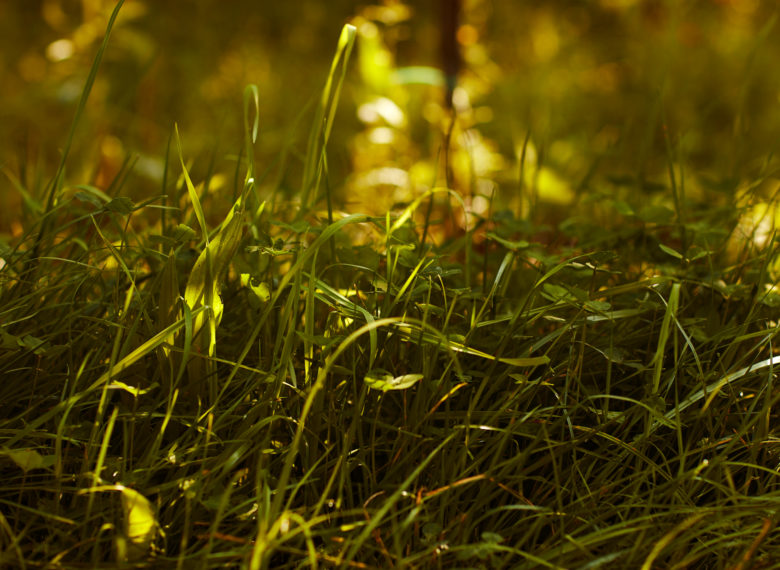
The water-meadows next to Burge’s Field fell out of use between the wars so we can’t go the whole hog, but we have started running sheep through the vineyard for a month or so after harvest and for a month or so just before bud burst. Their dung fertilises, improves the soil structure and is enjoyed by micro-organisms and plants alike - we think it has such a beneficial effect that, if we could only find some that don’t like the taste of vine leaves, we’d have sheep year-round!
harvest is done
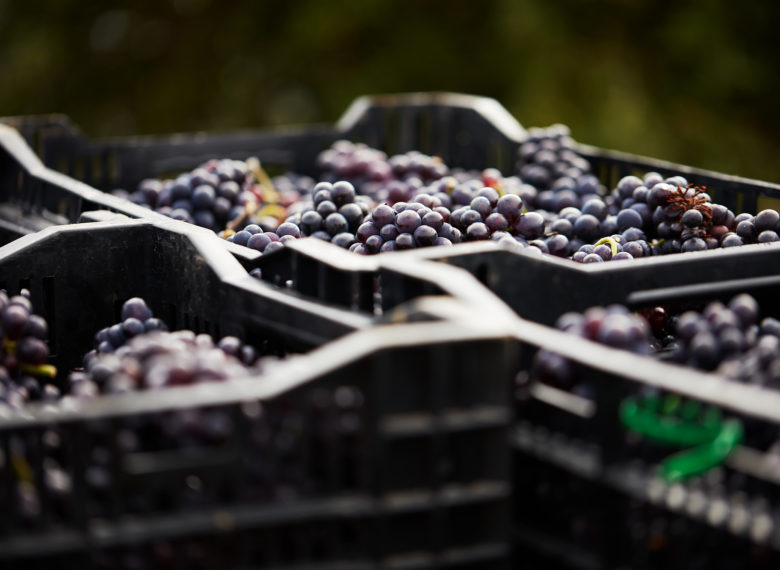
As gulls fly south to the coast our fourth harvest is gathered. It’s brought a difficult year to an end but, after all the weather has thrown at the vineyard over the last 6 months, there is a surprising sense of optimism… A 30 strong team has taken 5 days to pick, pack and deliver to the winery somewhere just short of 50 tonnes.
The Pinot Meunier, which was the least affected in the vicious frosts at the end of April, produced the best yield. The Chardonnay was hit the worst in April so, even though renowned as a heavy cropper, it only produced about the same as the Pinot Noir, which also fared badly in the frosts.
We have understood since April that our yields would be down but the upside was good ripeness - especially in a couple of the north blocks of Pinot Meunier. We left them a good bit longer as an experiment and, while the sugars didn't improve much since there isn't much photosynthesis going on at this time of year, the acidity levels dropped nicely - should be very good for the PINK.
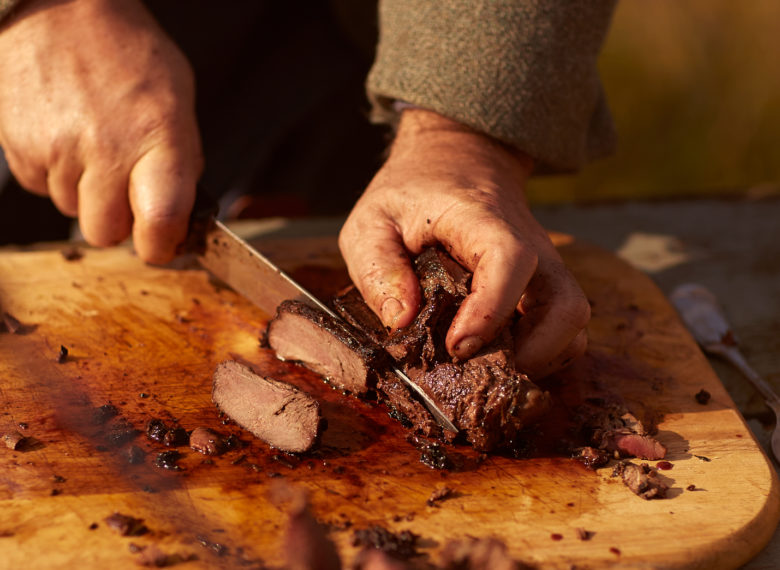
At noon on the last day Rose and Barnaby appear with two enormous legs and two fillets of venison. This is fallow deer from the woods around the Grange and the meat has been marinading overnight in wine and garlic and thyme. The flavour-laden smoke from the two oil-drum barbecues makes everyone pick and stack the last few rows that little bit faster.
At three in the afternoon it is finished and the team falls on rolls stuffed with rare meat and crunchy coleslaw, a glass of warming Tempranillo washes the rolls down and then Lucy produces mountains of brownies.